
U.S. HEALTHCARE SYSTEM - HCA520- 4.4

Content organized by Thais Costa de Souza and adapted by Prof. Dr. Angela Lopes, from the book The Well-Managed Healthcare Organization, Eighth or Ninth Edition, published in 2016/2019 by Kenneth R. White and John R. Griffith.
Latin American Healthcare Systems
Latin American health systems are heterogeneous. Next we will highlight some characteristics concerning the historical development of the health systems of Mexico, Colombia, Peru, Argentina, and Chile.
The implementation of the welfare state was late and uneven among Latin American countries. In the early 1980s, as a result of the rising interest rates charged by the United States, many Latin American countries became defaulters, causing the institutional segmentation and operational fragmentation of social protection systems to increase inequalities in health coverage and access in these countries.
Health care reforms were carried out unevenly and gradually by countries in the 1980s and 1990s. Table 1 describes the historical context of Latin American countries before and after health care reforms.
Table 1: Historical context of Latin American countries before and after health system reforms
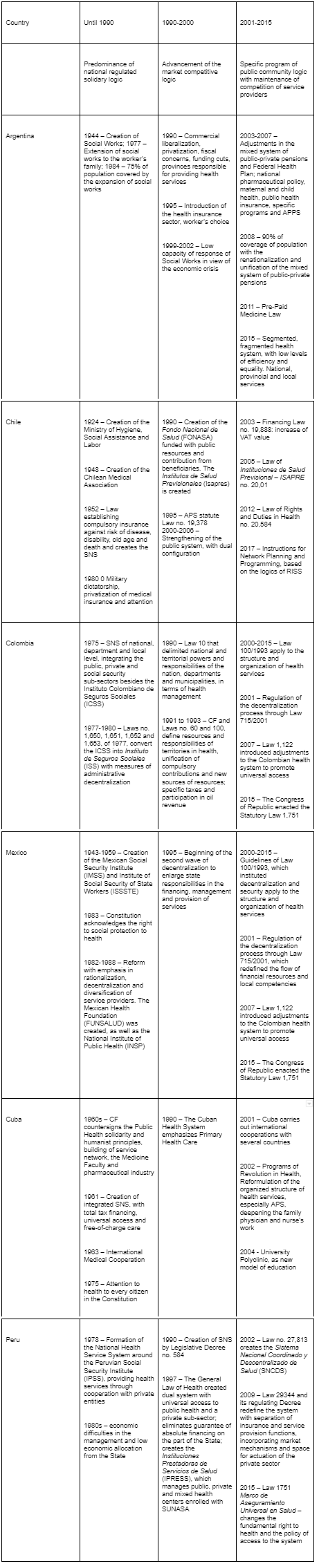
Caption: EC: Constitutional Amendment; APS: Primary Health Care; IVA: Value Added Tax; RISS: Integrated Health Service Networks; NHS: National Health Service; SUNASA: National Superintendence of Health Insurance; CF: Federal Constitution. Source: adapted from Fillipon et al. (2016).
Source: adapted from Göttems et al. (2021).
It can be observed that during the 1990s there was a tendency to redistribute service provision from national to local governments and to hand over the management, financing, and provision of health services to the private sector. Thus, there has been growth of private health plans, segmentation of coverage, and fragmentation in the provision of services. In Brazil, the opposite has happened, with the adoption of the Unified Health System [SUS], of universal character. After the 2000s, there was some return to public health concerns, while maintaining competition among health care providers.
Cuba, in turn, can be analyzed as a counterfactual, as it evolves from an already public and universal system in the direction of deepening and broadening the provision of health services, making this country recognized as successful in terms of health indicators.
Already in the first decade of this century, many countries have succeeded in reducing extreme poverty and social inequalities, generating increased income and formal employment, increased social spending, and tax reforms. The organizational characteristics of Latin American health systems are summarized in Table 2.
Table 2: Specific characteristics that have been introduced in the reforms of the selected countries.

Source: Adapted from Göttems & Mollo (2020, p. 5).
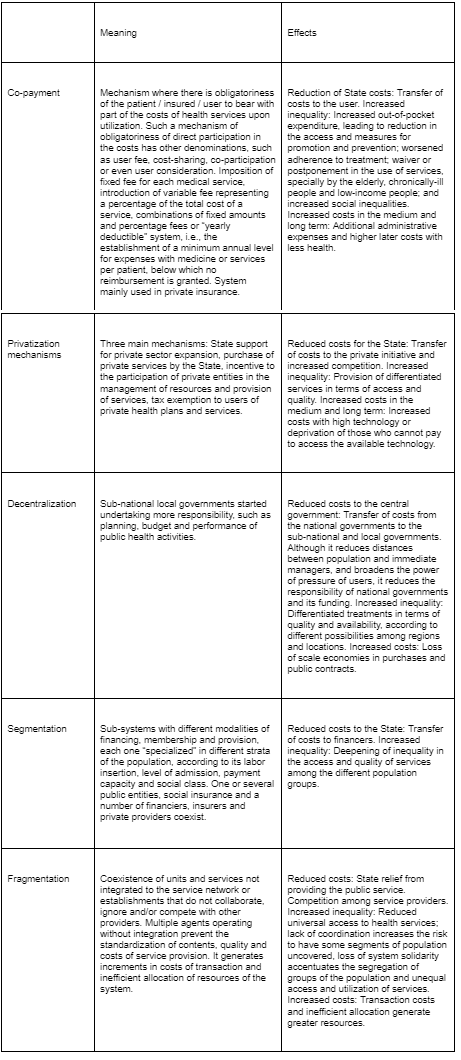
As can be seen in Table 2, four countries (Chile, Colombia, Peru and Mexico) have instituted co-payment models, whereby patients are required to bear part of the cost of health care services during utilization. The goals of this measure were to recover health care costs, provide additional funding, control the allegedly exaggerated demand for medical services, and limit unnecessary use. However, some negative effects have been observed, such as reduced access to promotion and preventive measures, worsened adherence to treatment, renunciation or postponement of the use of services, and increased social inequalities. All countries have stimulated, in different ways, the privatization and decentralization of health care systems. Table 3 summarizes the meanings and effects of the reforms on health systems.
Table 3: Meanings and effects of health care reforms.
Source: Göttems & Mollo (2020, p. 7).
Thus, it can be observed that health care reforms in Latin America were aimed at reducing costs in order to pay off each country's foreign debt. However, this unprotection of part of the population may amplify such costs in the future, due to the increase in cases with high levels of complexity. The segmentation of health services adopted by some countries can also provide increased inequality in access and quality of services for different population groups.
In this topic, the student learned about some of the health systems in place in Latin America. You observed that, among the health care systems studied, the Argentine and Cuban health care systems are the only ones funded by the federal government through tax revenues. The other countries adopted a system of co-payment, in which the user pays part of the costs of the procedures used. In addition, you observed that the health systems of these countries have diverse characteristics in terms of decentralization, fragmentation, and population coverage. In the next topic, you will learn about the health care system of the People's Republic of China. See you soon!
Want to learn more about the health systems adopted in Latin American countries? Access the link: https://bit.ly/08v17a and find out!
Bibliographical References
Göttems, L.B.D. & Mollo, M.L.R. (2020). Neoliberalismo na América Latina: efeitos nas reformas dos sistemas de saúde. Rev Saude Publica., v. 54, n. 74, p. 1-11. Disponível em: https://bit.ly/0b71va.
Levcovitz, E. & Couto, M.H.C. (2019). Sistemas de saúde na América Latina no século XXI. Brasília, DF: Observatório Internacional de Capacidades Humanas, Desenvolvimento e Políticas Públicas. Disponível em: http://capacidadeshumanas.org/oichsitev3/ wp-content/uploads/2019/02/4-Sistemas-de-sa%C3%BAde-na-Am%C3%A9rica-Latina-nos%C3%A9culo-XXI.pdf.
Göttems, L.B.D., Camilo, L.P., Mavrot, C. & Mollo, M.L.R. (2021). As reformas dos sistemas de saúde da América Latina: influências neoliberais e desafios aos Objetivos de Desenvolvimento Sustentável. Cien Saude Colet., v. 26, n. 10, p. 4383-4396. Disponível em: https://bit.ly/bi12ha.
U.S. HEALTHCARE SYSTEM - HCA520- 4.4
Latin American Healthcare Systems
Images: shutterstock


MUST University®: licensed by Florida Commission for Independent Education, License: 5593.